
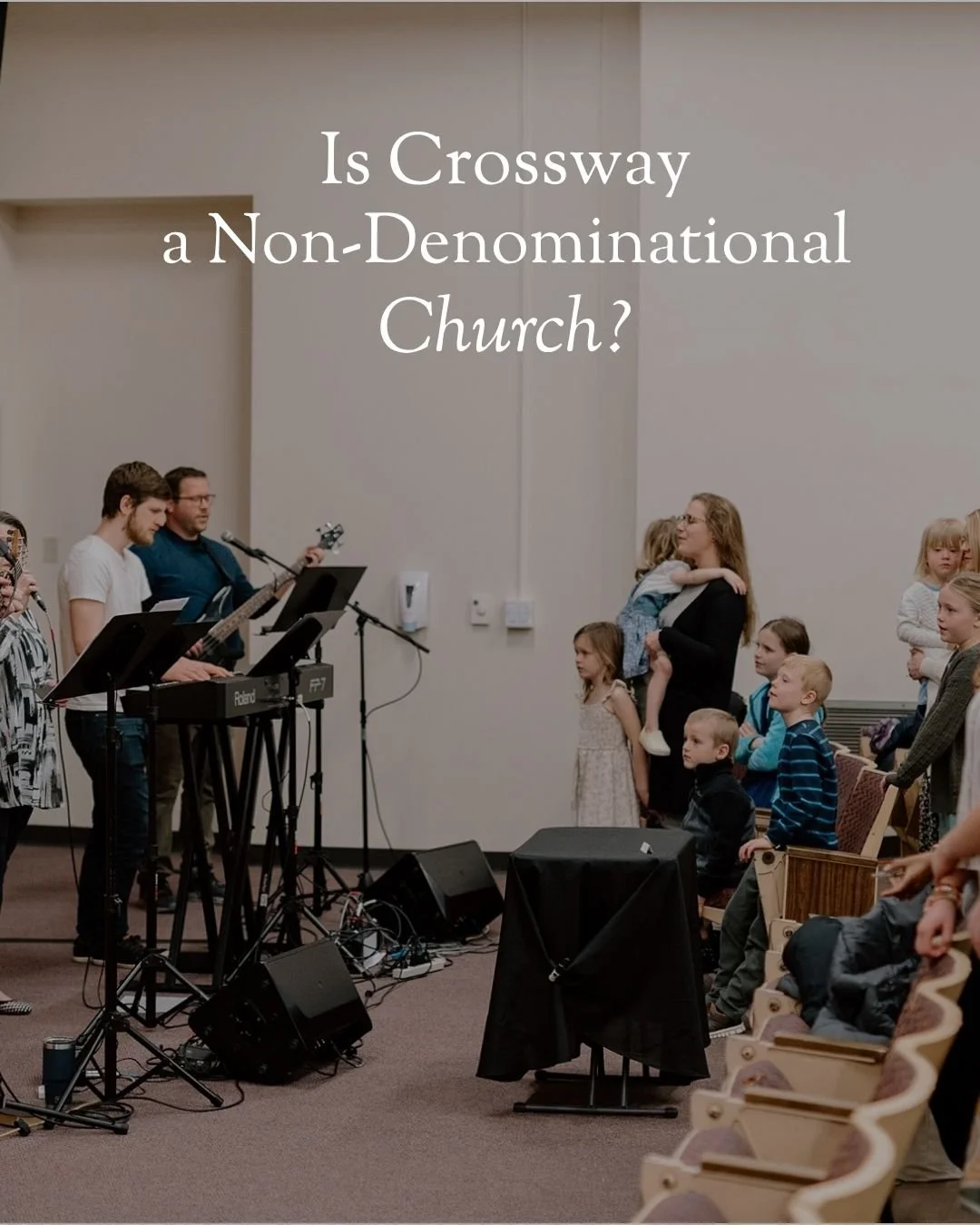
Is Crossway a Non-Denominational Church in Milwaukee?
Is Crossway a non-denominational church in Milwaukee?
Is CrossWay a Non-denominational Church in Milwaukee?
“Non-denominational church in Milwaukee” is a highly searched term when it comes to Christians looking for a church. Some people might recommend Crossway Milwaukee as a good fit for a non-denominational church. Others might cite that Crossway is part of the EFCA. Is Crossway Milwaukee Church non-denominational? It really depends on what you mean by “non-denominational”.
Is It About Who’s In Charge?
If by denomination you mean a top-down corporate hierarchy where a distant headquarters makes the decisions, assigns pastors and owns the building then no, we are not that. We don’t have a central office miles away deciding how we care for people right in our local church community. While other churches (like Lutheran churches) have synods or districts that make decisions, Crossway Community Church in Milwaukee is self-governing. At Crossway we have a team of elders who makes decisions, alongside congregational voting.
Is It About Tradition and Liturgy?
When you think about a non-denominational church in Milwaukee, you might be thinking of a place absent of strong tradition — things like liturgy, robes and formal ceremonies. It is true that churches in certain denominations have tradition. In the EFCA, it works a little differently. Each church is autonomous and individual.
As far as tradition and liturgy at Crossway goes, we do share some roots with these churches. We practice liturgy in our services — reciting the Apostle’s Creed together, practice corporate confession, and incorporate other historic elements of Christian worship. We hold to the same faith that Christians have always held. Our style is casual but our beliefs are not new and trendy - they are rooted in scripture and the beliefs that Christians have held since the beginning.
Where we stand: the EFCA
CrossWay began in 2008 as a non-denominational church plant on Milwaukee’s South Side. As a non-denominational church, CrossWay enjoyed the flexibility to forge its own path without the pressures and constraints of oversight from a larger denomination.
While this served CrossWay well in the past, we began pursuing a denominational affiliation in 2020 to strengthen our cooperation with local congregations throughout Milwaukee and southeastern Wisconsin. Although the list of denominations with which CrossWay could align was narrow, we ultimately chose to join the Evangelical Free Church of America (EFCA).
When people ask if we belong to a group, we tell them we belong to the EFCA (Evangelical Free Church of America). The key word in that name is “free”— it simply means that our local church is autonomous. Our local leaders, with input from our congregation, make the decisions and sheperd our community directly. However, we aren’t out here on our own island. Being part of the EFCA gives us strong partnership, rich resources, and a wider network of like-minded churches to serve God’s kingdom and the community around us.
The EFCA refrains from prescribing a particular position on certain theological issues about which faithful Christians may disagree. One example is the timing and mode of baptism. The EFCA explains its position this way:
Regarding the ordinance of baptism, we affirm this is a biblical/theological essential. The Lord Jesus mandated that the church celebrate the ordinances. It is not that this is a matter of indifference (adiaphora), since it is a clear command given by the Lord Jesus for the church to celebrate (Matt. 28:19–20). But the timing (paedo and credo) and the mode (sprinkling and immersion) we have placed in a category of silence, i.e. we will not divide over this issue. The EFCA is primarily believer baptism by immersion in both belief and practice. But there are also some churches who practice infant baptism, though not considered for salvation. We are baptist with a small “b” in that what is critical for membership in a local church is true salvation. The fact that both credo and paedo baptism are allowed is a “significance of silence” issue, i.e. we will debate it but not divide over it.
Uniquely, the EFCA emphasizes shared unity around essential convictions, including biblical inerrancy and sufficiency, rather than requiring a settled theological position on every major issue. As a result, membership in the EFCA reflects a spirit of cooperation grounded in our common unity in Christ.
It also provides healthy protection and accountability:
Outside Accountability: We deliberately choose to have pastors and leaders credentialed with the EFCA. This creates an objective standard of character and doctrine held by people outside our local walls.
Protection for the Congregation: If a leader ever becomes disqualified, abusive, or unqualified, we don’t have to handle it in a silo. We have a trusted, external network with the authority and experience to step in, provide discipline, and protect the church family.
Practical Partnership: It allows us to pool resources for global outreach, church planting, and practical care without losing our local identity.
What are people really asking when they are looking for a non-denominational church in Milwaukee?
When most people ask if CrossWay is a nondenominational church in Milwaukee they aren't looking for a lesson in church governance. They usually just want to know:
Will I be welcome if I don't have a church background?
Yes. You don't need to dress up, know the Bible inside and out, or pretend to have life completely together.
Are you focused on religious red tape or the Bible?
Our focus is simply on following Jesus, understanding the Scriptures, and helping each other live out the gospel in our everyday life.
Is this a safe, trustworthy place?
Yes. We combine the personal feel and freedom of an independent church with the safety and accountability of a healthy association.
The Bottom Line
At the end of the day, we care about being an authentic community anchored in the unapologetically ancient beliefs Christians have held for millennia — a place where you can ask hard questions, find real support, and explore faith at your own pace.
If you would like to learn more, please visit:
Blog Written by both Sam Park and Peter Merritt
Christian Counseling in Milwaukee
A Guide to Christian Counseling Resources in Milwaukee
By Samuel Park
When members of our church family face deep suffering, trauma, or the persistent weight of sin, seeking help is the right first step. However, navigating the world of counseling can be confusing. It is crucial to understand that not all counseling approaches are the same, even among those labeled “Christian.”
For those in Milwaukee looking for guidance, it is vital to discern the different counseling models available. Understanding these differences, without dismissing the good that each can offer, allows you to choose care that aligns with your specific needs and convictions while supporting true spiritual growth.
At a Glance: Comparing Christian Counseling Models in Milwaukee
Secular counseling
Primary Goal: symptom relief and practical coping skills
Ultimate Authority: Psychology and clinical research
Insurance: Covered by insurance with clinical diagnosis
clinically-informed christian counseling
Primary Goal: Treat clinical symptoms using both therapy and faith
Ultimate Authority: Integrated (psychology and Christian worldview)
Insurance: Covered by insurance through licensed clinicians
biblical counseling (ccef)
Primary Goal: Work through heart issues and bring Christ’s comfort to the sufferer
Ultimate Authority: Scripture (emphasis on grace and relationship)
Insurance: Not covered by insurance; out of pocket or paid by church
biblical counseling (acbc)
Primary Goal: Identify heart idols; call to dynamic repentance
Ultimate Authority: Scripture (emphasis on individual responsibility)
Insurance: Not covered by insurance; out of pocket or paid by church
Understanding the Models: Different Approaches to Soul Care
1. Secular Counseling
Secular counseling is built upon clinical research, human observation, and psychological theory. The foundation of this model is humanism—the belief that the ultimate authority and solutions to our problems reside within human understanding and methodology, rather than God. The primary goal is emotional stabilization and symptom management.
The Good: Regular, secular counseling can be incredibly helpful for managing severe mental health crises, understanding complex family dynamics, and offering practical coping skills. They utilize scientifically backed therapies (like CBT or EMDR) that can offer genuine relief from debilitating symptoms.
The Difference: Because it removes God from the equation, secular therapy lacks the biblical categories needed to address deep heart issues. It defines struggles in purely clinical or environmental terms, rather than addressing concepts like sin, repentance, or the worship of idols.
2. Clinically-Informed Christian Counseling / Integrationist
This second option consists of state-licensed mental health professionals (LCPCs, LCSWs, PsyDs) who operate from a Christian worldview but utilize clinical methods. They seek to integrate psychological literature and evidence-based therapies with biblical principles. Not all Christian counseling is the same, and the degree to which a counselor relies on Scripture versus psychology can vary widely.
The Good: For believers facing complex neurological issues, severe physiological trauma, or acute clinical depression, this model can be highly effective. These counselors have the clinical training to address severe psychological symptoms while still honoring the client’s faith and utilizing prayer or biblical wisdom.
The Difference: While they are Christians, the foundational framework often remains psychological. They diagnose using secular manuals (DSM-5) and utilize clinical models as the primary vehicle for treatment, whereas pure biblical counseling relies solely on Scripture.
Local & Regional Options for this Model:
Genesis Counseling Group (Elm Grove, WI): A local private practice clinic offering counseling services and psychiatric evaluation/medication management from a Christian perspective.
Christian Family Solutions (CFS): A larger regional organization providing licensed, evidence-based mental health care blended with Christian faith principles, including outpatient clinics and specialized care centers in the Milwaukee area.
Steeple Counseling (Arlington Heights, IL / Telehealth): A practice offering licensed professionals who aim to balance clinical excellence with biblical faithfulness. They offer virtual therapy sessions for those open to telehealth.
Pneuma Therapeutic Services (Chicago, IL / Telehealth): Utilizes evidence-based therapies alongside traditional counseling within a Christian foundation. They also provide remote telehealth services.
3. Biblical Counseling (ACBC & CCEF)
The foundational basis for true biblical counseling is a total commitment to the sufficiency and authority of Scripture in addressing the human soul. It asserts that faith must inform every area of life, and the ultimate goal is not just symptom relief, but a life that actively rejects sin and finds rest in the gospel.
While united in their commitment to Scripture, the two leading organizations in this field have distinct functional emphases:
ACBC (Association of Certified Biblical Counselors): The ACBC model strongly emphasizes individual responsibility and confronting sin. Counselors focus on helping an individual identify specific idols they have substituted for the worship of God. The primary goal is to call for dynamic repentance and strict, obedient adherence to biblical commands.
CCEF (Christian Counseling & Educational Foundation): While CCEF shares ACBC’s dedication to Scripture, their approach places a distinct functional emphasis on grace and relationship. CCEF excels at untangling complex heart issues, recognizing that we are not only sinners but also sufferers who require the compassion of Christ. They focus on bringing comfort to those in pain, helping them rest securely in God’s redemptive love.
How Insurance Comes Into Play
A practical question is how health insurance factors into these models.
Integrationist Practices DO generally accept insurance. Because organizations like Christian Family Solutions, Genesis, Steeple, and Pneuma employ state-licensed clinicians, they can legally provide medical diagnoses and bill for clinical treatment.
Pure Biblical Counseling (ACBC, CCEF) WILL NOT be covered by insurance. Insurance companies require a “medical necessity” based on a secular diagnostic manual (the DSM-5) to approve a claim. Biblical counselors generally refuse to apply a clinical diagnosis to a spiritual struggle just to facilitate billing. Furthermore, state licensing boards strictly require counselors to provide care based on objective, secular ethical standards, which creates a conflict for a counselor whose authority is exclusively God’s Word. Therefore, most biblical counselors operate entirely out-of-pocket or through church-supported ministries.
When life exposes our struggles and we find ourselves in need of help, understanding these differences is key. Whether you require the clinical care of an integrationist practice, or the soul-care of a CCEF or ACBC trained counselor, seek out care that will faithfully support your walk with Christ.
Disclaimer: CrossWay Community Church provides these local clinic names and links as helpful options for our congregation to explore. We do not officially endorse, oversee, or manage the clinical practices of these external organizations.
References & Resources
Association of Certified Biblical Counselors (ACBC): biblicalcounseling.com
Christian Counseling & Educational Foundation (CCEF): ccef.org
Christian Family Solutions (CFS): christianfamilysolutions.org
Genesis Counseling Group: genesiscounselinggroup.com
Pneuma Therapeutic Services: pneumatherapeuticservices.com
Steeple Counseling: steeple-counseling.com
What is the Gospel?
What is the gospel? The gospel message is the best news we have as believers! It’s an invitation to live in gospel freedom.
The question “What is the gospel?” is one I feel privileged to write about because, at its core, the gospel is an invitation from our Lord. In its most basic form, the phrase gospel means “good news,” and the very reason it is good news is because not only does it answer what is the deepest and most troubling problem every person faces, but, when received, it gives us the gift of being delivered from this problem. Despite modern day claims to the contrary, the foremost problem of humanity is not political, it is not economic, it is not social or cultural, and it is not psychological. Humanity’s central problem is a spiritual one, the problem of sin.
The Problem of Sin
Scripture tells us plainly that “…all have sinned and fall short of the glory of GOD…” (Rom. 3:23). Sometimes sin is overly characterized as poor choices, bad decisions, and wrongdoing, but from beginning to end, the Bible repeatedly affirms that sin is the condition of our heart that rebels against the Lord, that humankind has wandered away from Him (Is. 53:6; Ecc. 7:20). Genesis 1:31 tells us that was not the Lord’s design nor desire for His creation, but when sin entered the world, our relationship with God became fractured. This separation from, and rebellion against God is the problem every person on earth is faced with.
The seriousness of sin cannot be understated not only because of the fractured relationship, but because it violates the very essence of who God is. God’s holiness is such that He cannot dwell with sin (1 Sam. 6:20; Ps. 5:4; Hab. 1:13; 1 Jn. 1:5). And our Lord is also the God of perfect justice (Deut. 32:4; Ps. 89:14; Nah. 1:3), and because of this, God cannot simply overlook sin. Sin is a perversion of God’s character, it corrupts justice, it sabotages our ability to have a relationship with Him, and in every way, sin seeks to destroy God’s designs and patterns for the flourishing of His creation. Because of its devastating effects, Scripture tells us plainly that “…the wages of sin is death” (Rom. 6:23), and this is exactly why the gospel is necessary. Without the gospel, humanity remains lost and separated from the Author and Sustainer of life, wandering in darkness, confused and isolated, and cut off from the fullness of life God intended.
We all are in Need of Redemption
This is not just an abstract theological idea, but it is the ultimate personal reality for each and every one of us absent of the gospel. For many years of my life, I lived the consequences of this brokenness quite directly. From familial abuse to poverty to homelessness to a decades-long involvement in the criminal-legal system, I know firsthand what it means to experience and be culpable for the crushing weight of sin. And yet my experiences, as well as your own I would imagine, fundamentally underscores the truth the Bible has always declared which is this: Each of us desperately needs redemption.
The Good News offered through Jesus Christ
And this is the good news. God, in His infinite mercy, kindness, and love has made a way for us sinners to be rescued. Our rescue is found in the person and the work of Jesus Christ (Rom. 5:8). Jesus Christ, the Son of God our Father entered our broken and evil world, taking on human flesh (Jn. 1:14), and in doing so, Christ lived an exemplary, sinless life, perfectly obedient to our Father in every way (1 Pet. 2:22). Why? Christ came to stand in the place of sinners, to take upon Himself the very judgment that our sins deserve.
Jesus, in perfect submission to His and our Father, voluntarily and selflessly subjected Himself to brutal torture on a cross leading to His execution because it was His purposed and deliberate mission to deliver us from our sins, to reconcile us back to God. This is why the cross stands at the very center of the gospel, an event that was foretold hundreds of years beforehand (Is. 53).
But the gospel does not end at the cross, and it was not the end of the story. Three days later, Jesus rose from the dead because the grave could not hold Him any longer! God raised Him from the dead, vindicating His Son and declaring that the power of sin and its ultimate end of death had been destroyed (1 Cor. 15:3-4). Christ’s resurrection is God’s decisive act proving that Christ’s sacrifice for sin was accepted and that Jesus is our “…resurrection and [our] life” (Jn. 11:25), and that eternal life is a free and unmerited gift to all who place their faith in Him (Jn. 3:36).
So what does all of this mean?
An Invitation to Live in Gospel Freedom
The gospel is an invitation, but it demands a response. The gospel is not merely information to understand: it is truth that demands action. Jesus said it best: “…Repent and believe in the gospel” (Mk. 1:15). The Bible makes this promise to us. “…If you confess with your mouth that Jesus is Lord and believe in your heart that God raised Him from the dead, you will be saved” (Rom. 10:9).
This message is especially powerful for people who feel broken by their past. Many of us know what it means to carry regret, guilt, or shame. The gospel speaks directly into that reality. Scripture promises, “If we confess our sins, He is faithful and just to forgive us our sins and to cleanse us from all unrighteousness” (1 Jn. 1:9).
In short, no one, and I mean absolutely no one, is beyond the reach of God’s mercy. Jesus came for all sinners. It is my deep hope that this message speaks to those who may feel broken by their past, that it encourages those who may feel weighed down by their present, that it may bring comfort to those who are worrying about their future. It is my deepest hope that this message would help you to know that the answer lies straight in front of you-open, unobstructed, and unhindered-and that Jesus, my Lord and Savior, is waiting to receive you with His arms wide open.
And if you make this decision please celebrate, because that is truly good news!
Written by: member of Crossway Community Church

Youth Ministry in Milwaukee
At CrossWay Community Church in Milwaukee, we’re building a youth ministry that isn’t driven by hype, entertainment, or big events but by relationships. Research shows that the strongest factor in long-term faithfulness is when each student has at least one spiritually mature adult investing in their life. Our youth ministry focuses on discipleship, connection, and helping teens experience an authentic, embodied faith that lasts long after high school.
Youth Ministry in Milwaukee: Why We Do Discipleship Differently
If you’ve grown up in evangelical church culture, the typical story probably feels familiar: big youth rooms filled with loud music, high-energy retreats, and more pizza than anyone should reasonably consume. Yet even with all that activity, research continues to reveal a heartbreaking reality—roughly 70% of church-going youth walk away from the faith after high school. Seventy percent.
When you look more closely at the studies, you find something surprising: the biggest factor influencing long-term faithfulness isn’t the size of the youth group, the quality of the worship band, or a jam-packed calendar of events. The strongest predictor is far more personal— each student having at least one spiritually mature adult, outside their parents, who consistently invests in them during their teen years. That insight changes everything.
Our Philosophy at CrossWay Community Church
At CrossWay Community Church in Milwaukee, we’ve chosen a different path. We’re not trying to compete with flashy youth programs or entertain students into heaven. Instead, we want something deeper, something more meaningful, something that feels more like spiritual family than spiritual daycare.
Our youth ministry philosophy is simple: discipleship over entertainment, connection over consumption, and spiritual mothers and fathers rather than leaders with microphones. Even if our ministry never becomes “big,” we refuse to give teenagers a small vision of Jesus.
What Our Youth Ministry Looks Like
Our approach is built on a foundation of relational discipleship, expressed through three key convictions.
1. Maturity Is Holistic—Not Just “Knowing Bible Facts”
We long to see students experience progressive, whole-life transformation in every relationship: God, family, church, and the world. This includes cultivating confidence in Jesus, growing in gospel fluency, honoring parents, engaging in church life, building friendships marked by vulnerability and prayer, and developing a lifestyle of service, hospitality, and mission. And yes, youth really can live these things out!
2. Relationships Are the Strategy
Our model centers on spiritually mature young adults who walk closely with students. They read Scripture together, create space for honest questions, pray with them, and show up in the ordinary rhythms of their lives. These leaders seek to integrate students into the broader church family, not just a room full of foosball tables. Discipleship rarely takes place in rows, it happens in living rooms, backyards, coffee shops, car rides, and around shared meals.
3. A Simple, Sustainable Rhythm
Twice a month, students gather for an hour of Bible study or worldview conversations followed by an hour of relaxed connection and shared fun. Once a month, they spend time with other CrossWay families through bonfires, game nights, hikes, park meet-ups, serving opportunities, or cooking together. In these moments, teens spend time in homes, hear testimonies, and witness the gospel lived out in everyday life.
What Makes This Approach Different
This kind of ministry is slow work. It doesn’t generate flashy photos or inflate attendance numbers. It won’t produce rooms packed with glow-stick-waving middle schoolers every Wednesday night. But it does form students who genuinely know Jesus, know how to pray, understand repentance, articulate their faith, love the local church, and have seen authentic, embodied Christianity modeled by adults who care for them. And when they eventually leave home, they don’t leave Jesus behind like a childhood keepsake.
A Final Encouragement for Parents
Parents, you remain your children’s primary disciplers. Our role is not to replace you but to build scaffolding around you. We long to be a church where no teenager goes unseen, where older saints know their names and pray for them, and where each student has at least one godly voice saying, “I’m with you. I’m praying for you. I’m walking with you toward Jesus.”
This is the kind of youth ministry we’re building at CrossWay Community Church in Milwaukee. It may appear small from the outside, but by God’s grace it will not be shallow or easily shaken.
If you’re interested in serving as one of these spiritually invested adults, or if you’d simply like support as you disciple your own teens, I would love to talk with you. Whether you’re already connected or just exploring youth ministry in Milwaukee, you’re warmly invited to join us.
Yours in Christ,
Sam Park


Why Join a Small Group?
Life is messy, but you don’t have to walk through it alone. Discover how CrossWay small groups bring believers together to share burdens, grow in faith, and find gospel-centered community in Milwaukee.
Small Group Bible Study in Milwaukee: How Small Groups bring gospel-centered community
About ten years ago, I attended my first Christian small group. I was a student at Bethlehem College & Seminary and joined a group of college and first-year seminary students. As a first-time attendee, I wasn’t quite sure what to expect. I imagined our time together would be spent talking about how wonderful our God is—praising Him for His kindness in each of our lives. I figured we’d open the Word and engage with deep truths that would leave me in awe of the greatness of God for days. I expected our meetings to be a consistent source of encouragement and spiritual fellowship. After all, wouldn’t a small group like this be perfect? My expectations were high.
It didn’t take long to realize that my perception of small groups was very different from the reality of small groups. What I thought would be a time of laughter and rejoicing often turned into evenings filled with tears and lament. The encouraging conversations I imagined frequently became hour-long discussions about the brutal facts of life—tough marriages, infertility, miscarriages, depression, financial hardship, and the loss of loved ones.
The point became clear: life is messy. Despite all the joys we experience, the walk of faith isn’t always easy. It’s often paved with unexpected challenges and hardships at every turn. Sometimes what we expect life to be doesn’t match what we live day to day. Christians aren’t immune to the effects of sin and the fall—and neither are small groups.
Small groups aren’t perfect - they’re powerful
Small groups aren’t designed to shield us from the world’s mess; they’re the battlegrounds where the truth of the gospel prevails over chaos. The community of believers has always been a people in the world, but not of the world. Jesus made this clear to His disciples.
“I do not ask that you take them out of the world, but that you keep them from the evil one. They are not of the world, just as I am not of the world.” – John 17:15-16 ESV
Jesus isn’t asking the Father to remove His followers from the world’s pain but to protect them from the schemes of the evil one. Like soldiers assembled for battle, He sends His disciples into the world to meet people where they are and to bring the light of the gospel into dark places. In the same way, small groups are places where the gospel meets life’s challenges. They’re open invitations to cast your cares onto Christ and to find strength and encouragement alongside fellow believers. Small groups provide an opportunity to be known by others as we make Jesus known to the world.

We Need One Another
At CrossWay Milwaukee, we believe it’s vital for every believer to be known by others in their local church. Whether it’s here at Crossway, or another small group in Milwaukee, we don’t encourage anyone to practice their faith in isolation, which is why we place such a strong emphasis on small groups to care for God’s people. We see the care of fellow believers as a pattern of life that began in the early church.
In Romans 12, Paul exhorts believers to “contribute to the needs of the saints” and to “rejoice with those who rejoice, weep with those who weep.”
Paul intends believers to be ready to carry one another's burdens and share in their joys. Small groups offer a unique opportunity to walk together in faith, growing in Christ’s likeness as we get to know one another. They provide a means of perseverance for every believer—through encouragement, the study of God’s Word, and the daily habits of grace we practice together. Simply put, small groups are how we make maturing followers of Jesus.
Small Groups at crossway: build community, share life
At CrossWay Community Church Milwaukee, small groups are made up of 10–15 members at various ages and stages of spiritual maturity. They are open to anyone and meet Monday through Thursday in the homes of CrossWay members. We intend for small groups to be a place of care and community among believers rather than a deep dive into Scripture, which takes place at other times. Small groups offer an opportunity to build a community of faith and to participate in meeting the needs of one another. If you’d like to join a small group, we encourage you to contact admin@crosswaymilwaukee.org to learn more or fill out our connection card!
Written By: Peter Merritt, elder at Crossway Community Church Milwaukee


Milwaukee Expository Preaching – Why It Matters at CrossWay
Expository preaching matters because people don’t need inspirational advice, they need the living God to speak through His Word. At CrossWay Community Church in Milwaukee, our sermons are built on the biblical text so you can hear Scripture clearly, understand it deeply, and see Christ lifted high week after week.
If you’ve visited churches in the Milwaukee area, you’ve probably noticed something: not all preaching is the same. At CrossWay Community Church in Milwaukee, we preach expository sermons because we believe God still speaks today through His Word, clearly, powerfully, and sufficiently. Preaching is not a place for opinions or personality-driven messages. It is where God’s voice is heard.
This isn’t just a stylistic preference. It’s a conviction about what people truly need. We don’t ultimately need spiritual pep talks or inspirational advice; we need the living God to speak. We need clarity in a confusing world and truth in a loud world. We need Jesus held up before our eyes week after week. That is why expository preaching matters.
What Is Expository Preaching?
Expository preaching simply means that the main point of the sermon is the main point of the biblical text. It often includes, as it does here at Crossway, going through a book of the Bible week by week, rather than having sermons that are topical in nature. The preacher doesn’t invent a message; he submits to it. Faithful exposition begins with the biblical author’s intent, draws out the meaning inspired by God, shows how the passage fits within the story of redemption, and then applies it to the church today in light of Christ.
Put plainly, if the sermon’s main idea is not the text’s main idea, it isn’t expository preaching. This protects the church from ego-driven preaching, cherry-picked verses, and sermons built on agendas rather than God’s revelation.
Martyn Lloyd-Jones once said, “The preacher is not there to air his opinions but to proclaim what God has said.” John Stott echoed the same conviction: “We stand under Scripture, not over it. Our responsibility is to open it, explain it, and apply it.” That is the heartbeat of expository preaching.
Expository, Exegetical, and Topical—What’s the Difference?
Exegetical preaching uses sound exegesis to draw the meaning out of the text. It is necessary for faithful preaching, but it does not automatically make the sermon expository. Expository preaching goes further by building the entire sermon around one passage’s main point. The structure, the aim, and the emphasis all flow from the text itself. This is why expository preaching often works best when moving through books of the Bible week by week. It trains believers to think biblically, not merely to think like the preacher.
Topical preaching, on the other hand, begins with a subject such as marriage, anxiety, or money and then brings various passages together to address that topic. It can be helpful, but it can also drift into selective proof-texting if not handled carefully.
At CrossWay Church in Milwaukee, expository, text-driven preaching is our normal diet. Topical sermons are occasional supplements, not the main meal.
Why Expository Preaching Matters for Your Soul
Expository preaching ensures that God, not the preacher, sets the agenda. The text determines the message, tone, and urgency. Over time, it teaches you how to read your Bible well, how to see context, themes, and the sweep of Scripture for yourself. It also keeps us from skipping the hard parts. We do not avoid difficult doctrines or uncomfortable passages because God included them for our good.
Most importantly, expository preaching keeps Christ at the center. It is not dry commentary; it is showing how every passage points us to Jesus. Charles Spurgeon put it bluntly: “No Christ in your sermon? Then go home, and never preach again until you have something worth preaching.” The goal is always the same: to build durable faith. Emotional inspiration fades, but God’s Word gives roots.
Scripture’s Own Model of Expository Preaching
This approach to preaching is not new. Nehemiah 8:8 gives a simple pattern: “They read from the book… clearly, and they gave the sense, so that the people understood.” Read the text. Explain the meaning. Apply it.
Paul gives the same charge in 2 Timothy 4:2: “Preach the word; be ready in season and out of season.” Not opinions. Not trends. The Word.
Why We Preach This Way at CrossWay
We preach expositionally because we believe Scripture is God-breathed truth (2 Timothy 3:16), because we trust the Holy Spirit to work through His Word, and because the church is healthiest when it receives the whole counsel of God. Real transformation happens as Christ is proclaimed from every passage.
Alistair Begg summarizes it well: “The pastor’s job is to teach the Bible. The Holy Spirit’s job is to convince and convert. Do not ever confuse the two.” Our aim is not for people to leave thinking, “That was clever,” but rather, “I met God in that text today.”
Looking for Expository Preaching in Milwaukee?
If you’re searching for a church where sermons are built from Scripture rather than opinions, where Jesus is preached from every passage, and where you’re invited to think deeply and live joyfully under God’s Word, we would love to welcome you to CrossWay Community Church. Learn more about us here!
Bring your Bible. Bring your doubts. Bring your need. You will hear the Word of God. You will see Jesus lifted high. And you will find a people being shaped by grace and truth.
Yours in the greatest cause,
Sam Park

A brief history of Crossway Community Church Milwaukee
Discover the story of CrossWay Community Church in Milwaukee, from its first service in 2008 to its mission today of making maturing followers of Jesus. Learn how our gospel-centered community has grown through multiple locations, faithful believers, and a commitment to family, fellowship, and living out the gospel in the city.
The Story of CrossWay Community Church: Gospel-Centered Ministry in Milwaukee
Every family, company, country, and church has a story. CrossWay Community Church in Milwaukee is no exception. Our journey has been shaped by faithful believers, challenges, and the desire to make maturing followers of Jesus.
Our Beginning: The First Sunday Service in 2008
In February 2008, CrossWay held its first official Sunday morning service. The original planting team, mainly families from CrossWay Bristol, shared a vision to plant more gospel-preaching churches in Milwaukee. This marked the start of our unique story in the city.
Moving Through Milwaukee: Our Early Locations
Our early years were nomadic, with multiple meeting spaces:
Pulaski High School (2008–2016)
We rented space in classrooms, enduring hot summers without AC and cold winters during school breaks. Children’s rooms met in chemistry and biology labs—simple, yet full of life.
St. Joseph Elementary School (2016–2019)
We moved to St. Joseph Elementary for better space, but after renovations, our meeting space became a gym with poor acoustics.
Alverno College (current)
Our current location provides a theater space with excellent sound and clean classrooms for children, creating an environment that brings joy to long-time attendees.
Connecting with Other Churches: Accountability and Collaboration
In 2013, CrossWay helped launch the CrossWay Association, connecting six local churches in Illinois and Wisconsin for mutual support. Though the association dissolved in 2018, our desire for connection continues. In April 2023, we officially affiliated with the Evangelical Free Church of America (EFCA) and actively participate in the EFCA Forest Lakes District.
Our Mission and Theology
Despite challenges and location changes, our mission remains: making maturing followers of Jesus by the power of the gospel. Theologically, our elders are Reformed Baptist, though this is not required for membership. We preach expositionally, move between the Old and New Testaments, and emphasize family and fellowship in a gospel-centered community.
What Makes CrossWay Community Church Unique
We are ordinary people worshiping the extraordinary Savior. At CrossWay, we encourage taking gospel risks, serving beyond comfort zones, and embracing a humble, family-oriented atmosphere. Our ministry in Milwaukee focuses on living out the gospel in everyday life, creating a community of disciples who shine Christ’s glory in our city.
Written by: Dan Allen
We would love to have you join us at Crossway Community Church if you are looking for a place to worship in Milwaukee! You can visit our “Plan Your Visit” page to learn all about what to expect. We worship at 10 am on Sundays at Alverno College. Hope to see you there!